Transforming higher education: the impact of artificial intelligence in keralas academic landscape
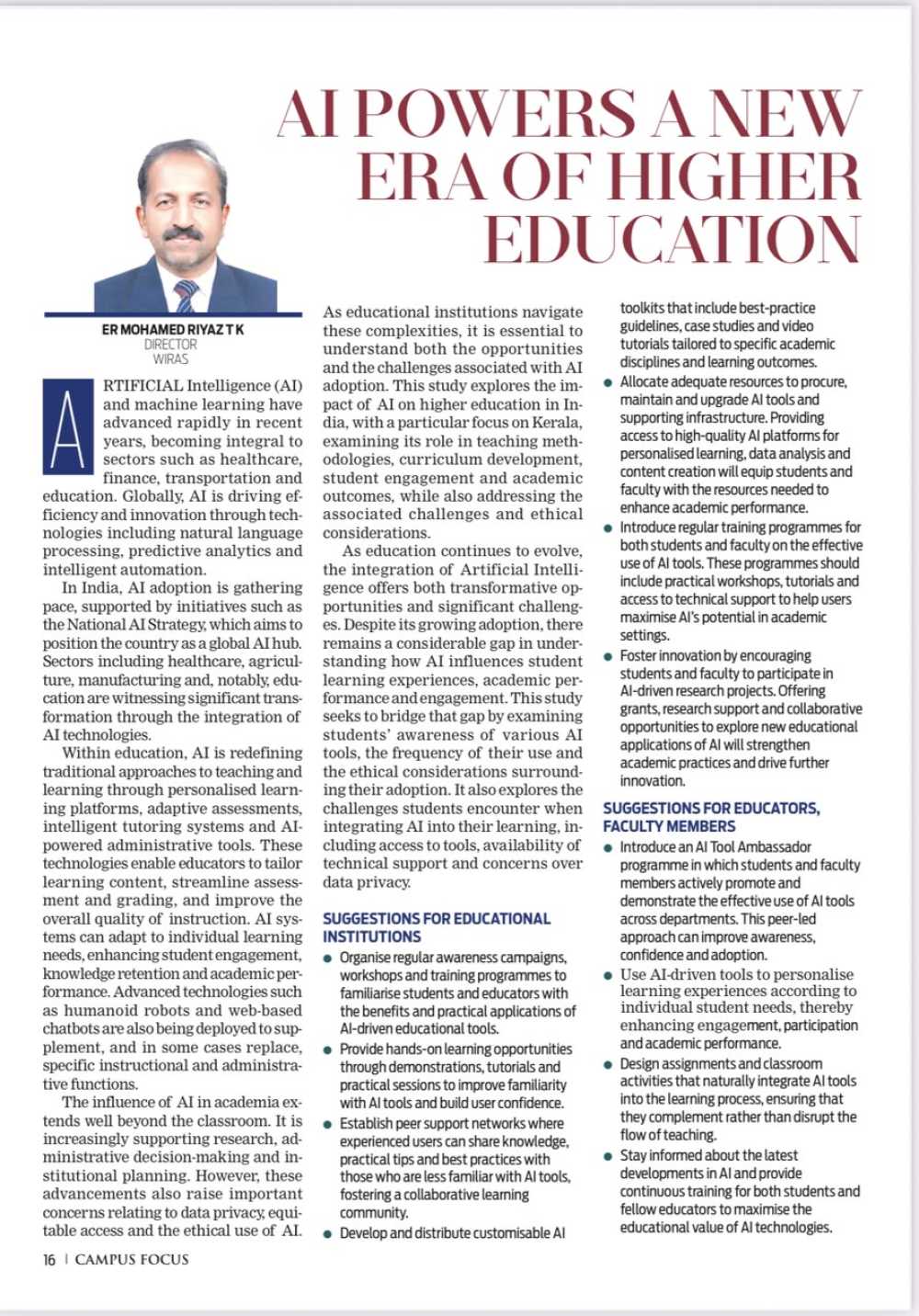
Artificial Intelligence (AI) and machine learning have rapidly advanced in recent years, becoming integral to various sectors including healthcare, finance, transportation, and education. Globally, AI is enhancing efficiency and innovation through technologies like natural language processing and predictive analytics. In India, AI adoption is accelerating, supported by initiatives such as the National AI Strategy, which aims to position the country as a global AI hub. Sectors like healthcare, agriculture, manufacturing, and especially education are witnessing significant transformations due to AI integration. In the field of education, AI is reshaping traditional learning approaches through personalized learning platforms, adaptive assessments, intelligent tutoring systems, and AI- powered administrative tools. These technologies support educators in tailoring content, grading efficiently, and improving the overall quality of instruction. AI systems can adapt to individual learning needs, promoting better engagement, retention, and academic performance. Advanced tools like humanoid robots and web-based chatbots are also being used to supplement or replace certain instructional and administrative roles. The influence of AI in academia extends beyond the classroom to include research facilitation, administrative decision-making, and institutional planning. However, with these advancements come challenges related to data privacy, equity,
and ethical AI use. As the education sector navigates these complexities, it is essential to understand both the benefits and implications of AI adoption. This study focuses on exploring the impact of AI on higher education in India, particularly in Kerala, by examining its role in teaching methodologies, curriculum development, student engagement, and academic
outcomes, while also addressing associated challenges and ethical considerations.In the evolving landscape of education, the integration of Artificial Intelligence (AI) technologies offers both transformative potential and challenges. However, a significant gap exists in understanding how AI impacts student learning experiences, academic performance, and engagement. This study seeks to address this gap by exploring the extent of students' awareness of various AI tools, the frequency of their usage, and the ethical considerations
surrounding their adoption. Additionally, it examines the challenges faced by students in integrating AI into their learning processes, such as access to tools, technical support, and data privacy concerns.
Suggestions for Educational Institutions
1. Organize regular educational campaigns, workshops, and training sessions within
institutions to raise awareness about the benefits and usage of AI-driven educational
tools.
2. Focus on hands-on experiences, such as demos and tutorials, to improve familiarity
and build confidence among students and educators.
3. Establish peer support networks where experienced users can share tips and best
practices with less familiar users, fostering a community of learners who help each
other improve their understanding and usage of AI tools.
4. Develop and distribute customizable AI toolkits that include best practices, case
studies, and video tutorials tailored to specific academic disciplines or learning
outcomes.
5. Institutions should allocate resources to procure and maintain cutting-edge AI tools
and infrastructure. By providing access to high-quality AI platforms for personalized
learning, data analysis, and content creation, institutions can ensure students and
faculty have the necessary tools for enhancing academic performance.
6. Educational institutions should establish regular training programs for both students
and faculty, focused on the effective use of AI tools. These programs should include
hands-on workshops, tutorials, and access to technical support, helping users fully
leverage AI's potential in academic settings.
7. Institutions can foster innovation by encouraging students and faculty to engage in
AI-driven research projects. Offering grants, research support, and collaboration
opportunities for projects that explore new applications of AI in education will
enhance the tools' effectiveness and drive further advancements in academic
practices.
Suggestions for Educators and Faculty Members
1. Establish a program where students and faculty members become "AI Tool
Ambassadors" who actively promote and demonstrate the benefits of AI tools in
various departments. This peer-led approach can increase awareness and comfort
with AI tools.
2. Educators can use AI-driven tools to tailor learning experiences based on individual
student needs and they can enhance student engagement and academic performance.
3. By designing assignments or activities that naturally incorporate AI tools, educators
can make the tools a valuable part of the learning process without disrupting the
flow of lesson
4. To maximize the effectiveness of AI tools, educators should stay updated on advancements and provide ongoing training for both students and them.